The STAR Method Template: A Fill-in-the-Blank Framework for Any Behavioural Question
By Rehearsa Team · 2026-07-30
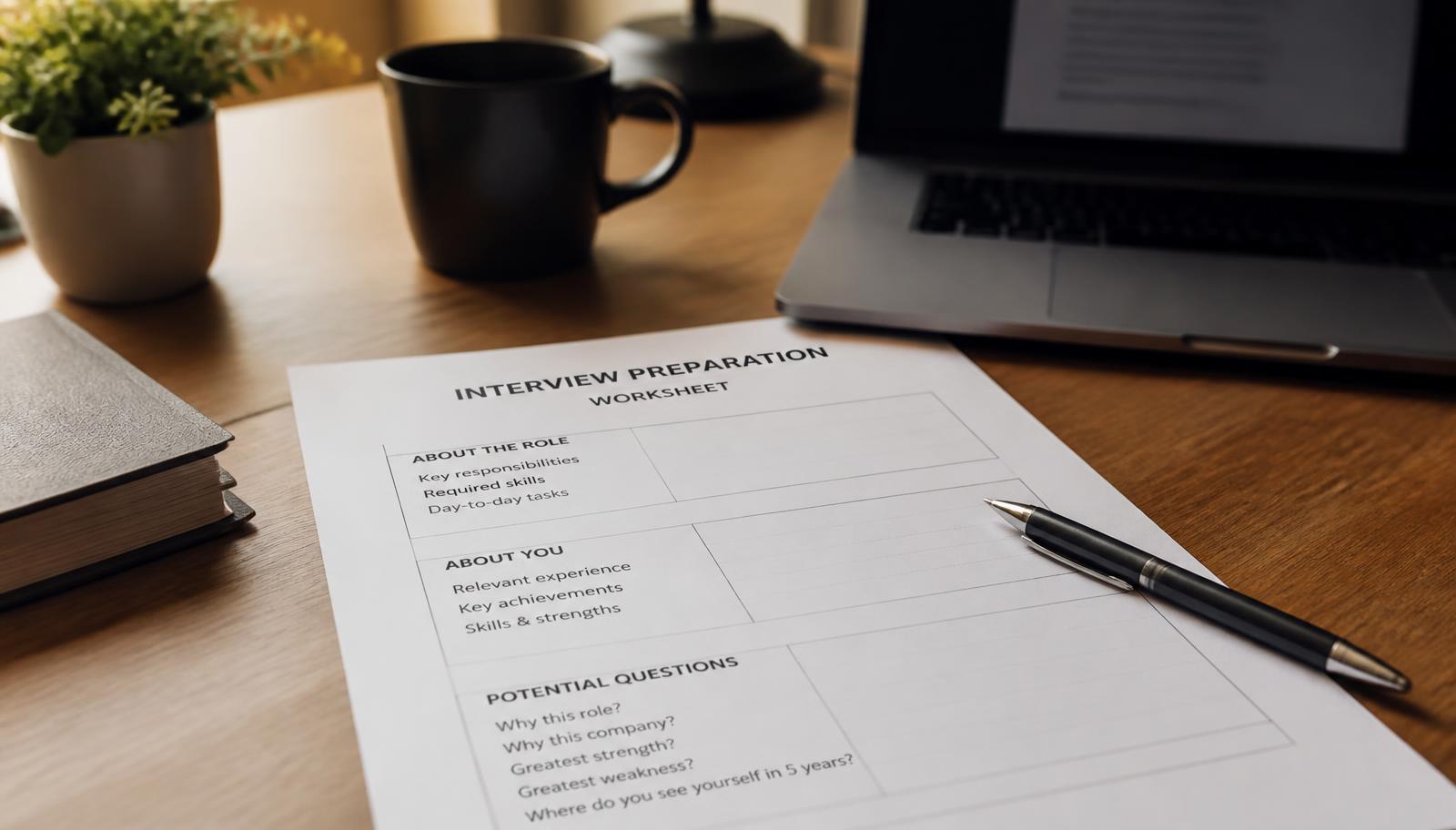
Most candidates do not fail behavioural questions because they lack experience. They fail because they have to invent a structure live, under pressure, while a stranger stares at them. The fix is boring and effective: bring a template.
This guide gives you a fill-in-the-blank STAR template you can apply to any behavioural question, the exact sentence starters that keep you on track, target word counts for each section, and a prep grid for building a story bank you can reuse across every interview.
If you are new to the framework, start with the complete STAR guide. If you want finished answers to model, see 25+ STAR examples.
The template at a glance
| Section | Purpose | Target length | Share of answer |
|---|---|---|---|
| Situation | Set the scene in one breath | 2–3 sentences (~40 words) | 15% |
| Task | State your specific responsibility | 1–2 sentences (~25 words) | 10% |
| Action | Show what you did, step by step | 5–7 sentences (~120 words) | 60% |
| Result | Quantify the outcome and reflect | 2–3 sentences (~40 words) | 15% |
A strong answer runs 90 seconds to 2 minutes — roughly 220–280 spoken words. Anything past three minutes and the interviewer stops listening and starts waiting.
The fill-in-the-blank template
Copy this into a document and complete one copy per story.
Situation
"At [company / team], I was [your role] when [the trigger event or problem]. The stakes were [why it mattered — deadline, revenue, customer, risk]."
Rules: name the context, the problem, and the stakes. Nothing else. No org charts, no backstory, no history of the department.
Task
"My responsibility was to [specific, measurable objective] by [deadline or constraint]."
Rules: this is your mandate, not the team's mission. If you cannot say "I was responsible for…", you have picked the wrong story.
Action
"First, I [diagnostic step — how you understood the problem]. Then I [decision you made, and the option you rejected]. To bring people with me, I [communication or stakeholder step]. When [obstacle appeared], I [how you adapted]. I also [the detail that shows judgement, rigour, or care]."
Rules: five verbs, all first person. Every sentence starts with "I". Include one decision where you chose between two options — that is where interviewers hear seniority. Include one obstacle — a story with no tension proves nothing.
Result
"As a result, [metric moved from X to Y] within [timeframe]. [Second-order effect — what it unlocked, who adopted it, what changed permanently]. Looking back, [what you learned or would do differently]."
Rules: at least one number. If you genuinely have none, use a proxy: time saved, complaints reduced, a process still in use, a person promoted, a client renewed.
Sentence starters that keep you on track
Under pressure, the first three words of each section do most of the work. Memorise these, not a script.
- Situation: "This was during…" / "The context was…"
- Task: "I owned…" / "My job was specifically to…"
- Action: "The first thing I did was…" / "I decided to… rather than… because…"
- Obstacle: "Halfway through, we hit…" / "The complication was…"
- Result: "The outcome was…" / "Within [timeframe], we moved from… to…"
- Reflection: "What I took from that was…" / "If I ran it again, I would…"
A worked example using the template
Question: "Tell me about a time you had to deliver under a tight deadline."
Situation. "At a B2B software company I was the product manager for our billing module when our largest client gave us six weeks' notice that a regulatory change would make our invoicing non-compliant. Roughly 40% of annual revenue sat with clients affected by the same rule."
Task. "I owned getting a compliant invoicing flow into production before the regulation took effect, without pulling the platform team off their security roadmap."
Action. "First, I mapped every invoice type against the new rule and found only three of eleven were actually affected — that cut the scope by two-thirds. Then I chose to patch the existing engine rather than rebuild it properly, because a rebuild would have taken twelve weeks; I documented the shortcut as tech debt with an owner and a date so it would not quietly become permanent. To get buy-in, I walked the engineering lead and the CFO through both options with cost and risk side by side, and let them pick. Two weeks in, our tax advisor changed their interpretation of one clause, so I ran a same-day session with legal and engineering and reworked one calculation instead of restarting. I also wrote the client-facing note myself so account managers were not improvising explanations."
Result. "We shipped eleven days before the deadline with zero compliance findings in the client's audit. The client renewed for two years, worth about £480k, and the scoping approach I used became the default template for regulatory work. What I took from it was that scoping ruthlessly early buys more time than working faster ever does."
That answer is 265 words. Say it out loud and it lands at roughly 1 minute 50 seconds.
Build a story bank, not a script
You do not need a story per question. You need 8–10 flexible stories that can be angled at whatever gets asked. Fill in this grid once and you are prepared for almost any behavioural round.
| # | Theme | Your story (one line) | Headline metric |
|---|---|---|---|
| 1 | Leadership / influence without authority | ||
| 2 | Conflict with a colleague or stakeholder | ||
| 3 | Failure and what changed after | ||
| 4 | Tight deadline / pressure | ||
| 5 | Ambiguity — no clear brief | ||
| 6 | Difficult customer or client | ||
| 7 | Data-driven decision | ||
| 8 | Process you improved | ||
| 9 | Something you learned fast | ||
| 10 | Cross-functional collaboration |
How to angle one story at several questions: the same project can answer "tell me about a conflict", "tell me about a tough deadline", and "tell me about a decision you regret" — you simply change which part of the Action section you expand. Prepare the story once; rehearse three different emphases.
Pre-interview checklist
Run this the night before.
- Every story has a number in the Result.
- Every Action section uses "I", not "we", at least five times.
- Every story contains one obstacle and one decision.
- No story is older than five years unless it is exceptional.
- Each story is under two minutes spoken — timed, not guessed.
- You can state each story's Situation in a single breath.
- At least three stories map to the priorities in the job description.
Common ways the template goes wrong
Even with a template in hand, the same errors recur — Situation bloat, "we" language, missing results, and over-scripting that makes you sound rehearsed rather than prepared. We covered all ten in STAR method mistakes. The short version: the template is scaffolding for your thinking, not a script to recite. Fill it in, rehearse the shape, then throw the paper away and speak like a person.
Practise it out loud
Reading a template feels productive. Saying it out loud is what actually changes your performance — that is where you discover your Situation runs 90 seconds, your Action drifts into "we", and your Result has no number.
Record yourself answering three behavioural questions with the template, then check your structure, pacing, and filler words. Rehearsa scores exactly that — answer structure, content quality, and delivery — so you can see whether your STAR answers land before a real interviewer hears them.